C Corporation Benefits & Tax Treatment: Taxes & Growth
August 17, 2026
2026 Year-End Bookkeeping Checklist | FSMC
October 15, 2026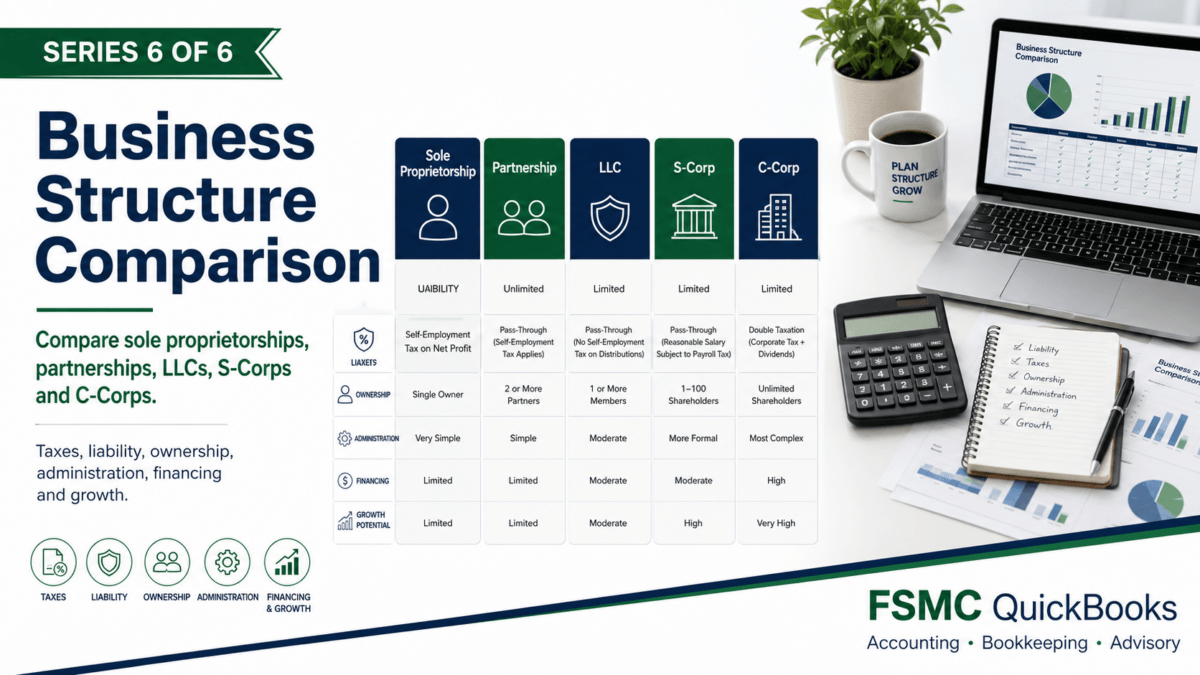
As a business owner, understanding the nuances of your business structure is pivotal for effective financial management and growth. The choice between structures like sole proprietorships, partnerships, LLCs, S-Corps, and C-Corps can significantly affect your ownership, liability, taxes, payroll obligations, administration, financing options, and long-term growth plans. This article provides a comprehensive business structure comparison to recap previously examined details and help you make informed decisions.
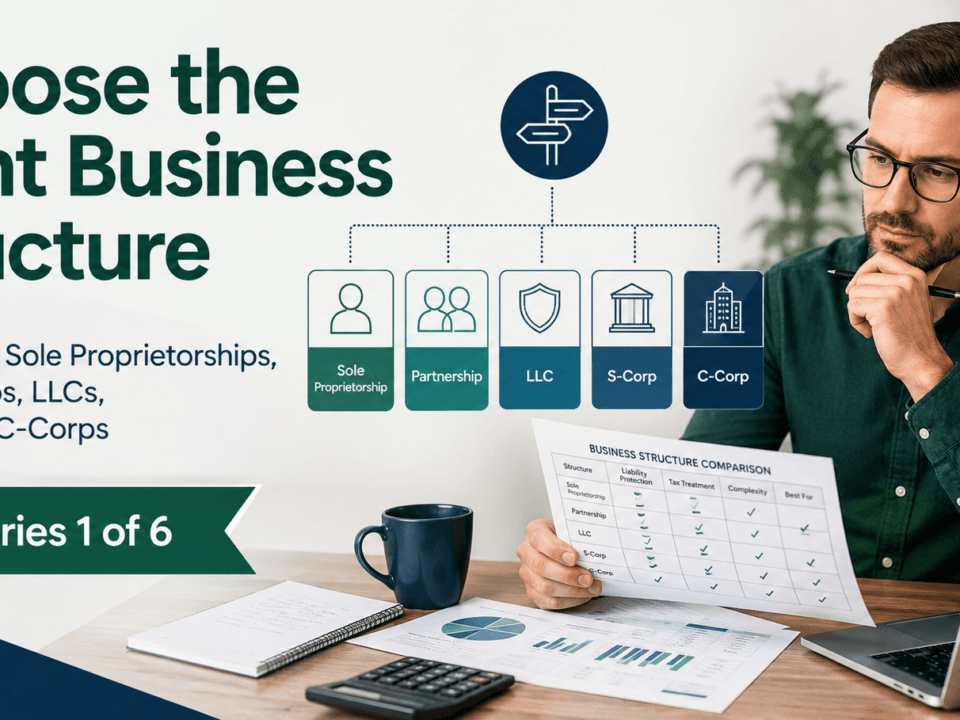
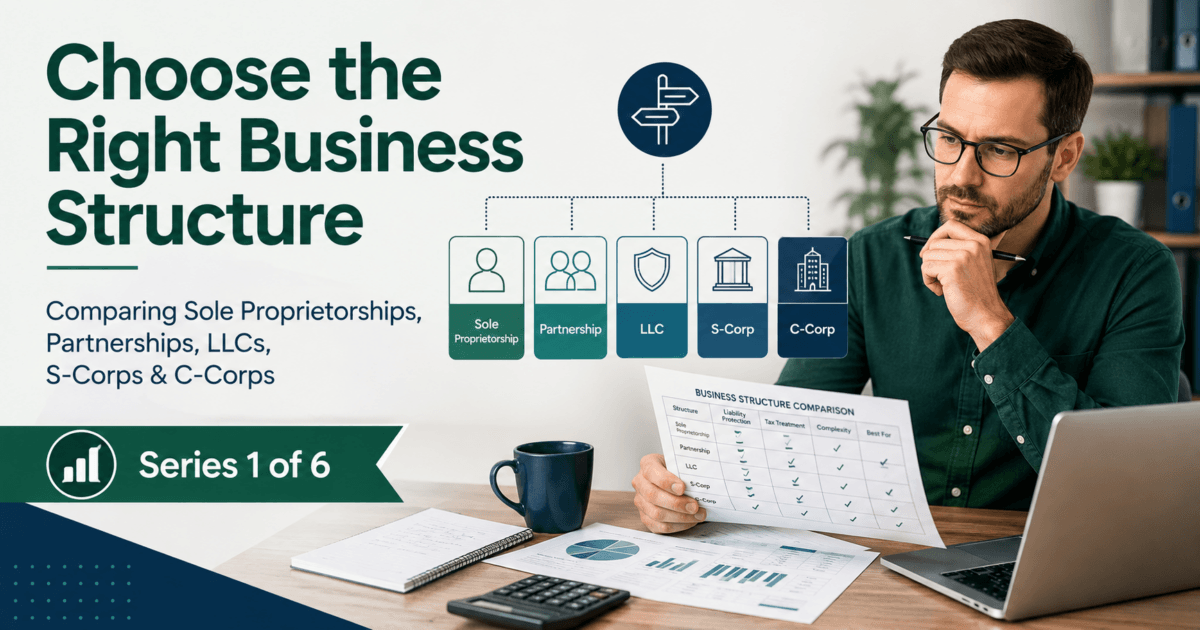
Key Business Structures Overview
- Sole Proprietorship: The simplest form, primarily owned by one individual.
- Partnership: Owned by two or more individuals sharing profits, losses, and responsibilities.
- Limited Liability Company (LLC): A flexible structure offering liability protection and management benefits.
- S-Corporation: A federal tax classification that can be elected by eligible corporations and LLCs, allowing for pass-through taxation.
- C-Corporation: A standard corporation subject to corporate tax rates, allowing for unlimited growth through stock issuance.
Comparison Table of Business Structures
| Feature | Sole Proprietorship | Partnership | LLC | S-Corp | C-Corp |
|---|---|---|---|---|---|
| Number of Owners | 1 | 2+ | 1+ | 1–100 shareholders | 1+ |
| Legal Separation | No | Generally no | Yes | Yes | Yes |
| Default Federal Tax Treatment | Sole proprietor | Partnership |
Single-member LLC: disregarded entity by default. Multi-member LLC: partnership by default. |
Pass-through taxation after S-Corp election | Separate taxable entity |
| Common Tax Forms | Schedule C with Form 1040 | Form 1065 and Schedule K-1 |
Schedule C for many single-member LLCs; Form 1065 for many multi-member LLCs; Form 1120-S if S-Corp status is elected |
Form 1120-S and Schedule K-1 | Form 1120 |
| Self-Employment / Payroll Considerations | Owner generally pays self-employment tax on net business earnings | General partners may owe self-employment tax on qualifying earnings | Depends on federal tax classification and whether the LLC has employees | Shareholder-employees generally receive reasonable wages subject to payroll taxes | Employee wages are subject to payroll taxes |
| Administrative Complexity | Low | Low to Medium | Medium | High | High |
| Ownership Flexibility | Single owner only | Flexible among partners, subject to partnership agreement | High | More restricted due to shareholder eligibility and stock rules | High |
| Investor Suitability | Low | Moderate | Moderate to High | Moderate to High | Very High |
| Common Use Cases | Freelancers, independent contractors and very small ventures | Professional services and businesses with multiple owners | Small businesses, professional firms and growing companies seeking liability protection | Qualifying small businesses seeking pass-through taxation and structured payroll | Companies seeking outside investors, multiple classes of stock or significant growth |
Deducing Business Structure Needs
Each structure presents unique implications for ownership, liability, and taxes. Here’s a closer look at each one:
- Sole Proprietorship:
- Ownership: Single-owner control.
- Liability: Unlimited personal liability.
- Taxes: Earnings taxed as personal income.
- Use Cases: Best for small businesses and freelancers with minimal risk exposure.
- Partnership:
- Ownership: Shared control and responsibility.
- Liability: General partners have personal liability.
- Taxes: Profits pass through to partners’ personal returns.
- Use Cases: Professional services or family businesses.
- Limited Liability Company (LLC):
- Ownership: Flexible ownership structure.
- Liability: Owners have limited personal liability.
- Taxes: Can choose between corporation or pass-through taxation.
- Use Cases: Suitable for businesses that require flexibility and protection.
- S-Corporation:
- Ownership: Limited to 100 shareholders.
- Liability: Shareholders have limited liability.
- Taxes: Pass-through taxation, avoiding double taxation.
- Use Cases: Small businesses seeking investment while avoiding excessive taxation.
- C-Corporation:
- Ownership: Unlimited shareholders.
- Liability: Limited liability for owners.
- Taxes: Subject to corporate tax rates (double taxation).
- Use Cases: Large companies anticipating significant growth or public offerings.
Important Tax and Legal Distinctions
It’s vital to note that an S-Corporation is primarily a federal tax classification rather than an entity type like an LLC or C-Corp. Depending on your business, it may be beneficial to elect S-Corp status for tax purposes, even as an LLC or a corporation. The tax treatment can vary considerably based on your choice, and understanding these differences can inform your business decisions.
Conclusion and Decision Checklist
Choosing the right business structure requires a thorough understanding of how each affects your business operations and implications for taxes and personal liabilities. Consider the following checklist when determining your most suitable structure:
- Ownership Style: Do you want to be the sole decision-maker, or do you need partners?
- Liability Concerns: How much personal risk are you willing to take on?
- Tax Implications: Are you prepared to manage the complexities of corporate taxation?
- Administrative Duties: Are you ready for the potential increase in administrative and compliance responsibilities?
- Future Growth: What are your long-term plans, and do you anticipate needing additional investment or partners?
It’s always advisable to consult with qualified legal and tax professionals who can provide tailored advice to fit your specific situation.
If you’re exploring how to maintain accurate financial records and streamline your bookkeeping for your chosen entity structure, FSMC Bookkeeping Services is here to assist. By utilizing QuickBooks Online, we can help ensure accurate tracking of your income and expenses, making your business operations smoother and your financial organization stronger.
Related Business Structure Resources
For assistance in your bookkeeping and accounting needs, explore FSMC Bookkeeping Services today at FSMC Bookkeeping Services.